Question Frames for 5th Grade Language Arts Common Core Test

(This is the starting time post in a two-part serial)
The new question-of-the-week is:
What are practical ways to implement restorative practices?
At that place is more than and more interest in moving abroad from "traditional" school field of study and toward restorative practices. This series will explore what that kind of shift can expect similar—in practical terms—inside our schools and classrooms.
You might too be interested in a very popular post that previously appeared here: How to Do Restorative Justice in Schools.
Today, Dr. Sheila Wilson, Maurice McDavid, Timothy Hilton, Ashley McCall, Bryan Harris, and Kara Pranikoff contribute their commentaries. Y'all can listen to a ten-minute conversation I had with Sheila, Maurice, and Timothy on my BAM! Radio Show. You lot can also discover a list of, and links to, previous shows here.
"When You Know Improve, You lot Do Better!"
Dr. Sheila Wilson is a native New Orleanian. She currently works as a 5th form teacher in Virginia. In addition to instructional leadership, she serves to improve the capacity of students, teachers, and families through her roles as class chair, atomic number 82 mentor teacher, family-date liaison, and SCA adviser. Dr. Wilson is also an adjunct professor, conference presenter, and self-proclaimed lifelong learner. She is passionate about amplifying pedagogy, school leadership, and disinterestedness:
We are all familiar with the discipline practices of yesteryear, which would likely crusade whatever conscientious educator today to blench. Corporal penalty/traditional discipline practices were widely accepted and viewed equally a means of correcting unwanted negative behaviors. I can vividly think beingness a high school sophomore assigned to write 500 lines for being caught passing a note in the classroom. And who can forget the ultimate ... getting paddled in the principal's office! Even though information technology didn't personally happen to me (really), but the idea evoked fright in students of all ages and deterred most from mischievous acts. And so, why was corporal punishment acceptable then? Why is corporal penalization no longer an accepted field of study practice in most places? Is penalty designed for those who obey the rules or for others? These questions make me telephone call to heed the adage, "When yous know better, you do amend!"
Countless studies have shown that traditional discipline practices are no longer effective in today's schools. In fact, traditional practices were and so commonplace in part considering the power to employ an immediate consequence was less fourth dimension consuming for the i doling out the punishment. Even so, we now comprehend restorative practices because they draw their strength in their ability to empower students to learn from unacceptable choices, to sympathise their impact, and to grow personally in their ability to make more sound decisions and resolve problems. Restorative practices represent a positive step forrad in helping all students learn to resolve disagreements, take ownership of their behavior, and engage in acts of empathy and forgiveness.
There are many ways to implement restorative practices in the classroom. First, teachers tin can incorporate daily morning meetings to build relationships with students, get a sense of their social/emotional mindset, and fix the tone and focus for the instructional solar day. Teachers can besides utilize goal setting with their students as a restorative practice. With goal setting, students take ownership of areas they'd like to ameliorate (academically or socially), and they fix realistic and actionable steps to piece of work toward their goal. By providing individual goal conferences, teachers can cheque in to see if students are on track to meet their goals, and students larn to self-check and refocus as needed. Another useful strategy is when an unacceptable behavior has happened that the teacher allows the offended pupil to share how the law-breaking fabricated him/her experience. In this way, the offender is able to understand how his/her behavior impacts others and therefore empathise the perspective of the other person. Finally, there is keen restorative ability in having the educatee who has fabricated an unacceptable pick reverberate on his/her behavior in writing past addressing very specific questions like: What choice did I make? How did my pick impact others? Is in that location a better fashion that I could have addressed this situation? If I had the opportunity for a redo, would I make the same choice? Why or why non?
At that place are a number of benefits or restorative practices:
- Builds relationships
- Strives to be respectful to all
- Provides the opportunity for equitable dialogue and decisionmaking
- Involves relevant stakeholders
- Addresses harms, needs, obligations
- Encourages all to take responsibility
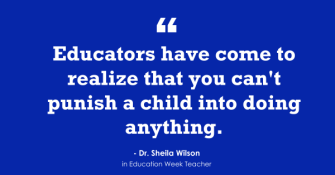
Educators have come to realize that you tin can't punish a kid into doing anything. Instead of just instituting harsh punishment, we need to teach kids the kind of skills, supported past enquiry, to assistance them improve their behavior. This is why districts are embracing the implementation of restorative structures in schools beyond the nation. In building socially responsible students, nosotros must arm them with the ability to think critically, trouble-solve, and be able to work collaboratively with others. Information technology will be through their mastery of bookish knowledge AND their capacity to engage successfully with others that will ultimately guarantee their future success. Therefore, as educators, nosotros must invest our efforts wisely.
Iv Restorative Practices
Maurice McDavid earned his bachelor's degree in elementary instruction with a minor in history and Castilian. He has taught middle school history, English language, and Spanish, also equally high school geography. He was dean of students for 3 years and is now in his commencement yr equally banana primary at a bilingual uncomplicated school.:
There are four restorative practices that I have worked to implement in our school building that all piece of work on the same model of restorative justice: customs-edifice circles, norm setting, community circles for content, and restorative chats.
Customs-building circles: This practise is smashing for the first of the year, as well every bit use throughout the year to build a customs of learners. This allows the students to get to know 1 another, also every bit the instructor. This practice builds empathy among the students and will reduce the negative attacking behaviors that can exist in classrooms.
Norm setting: This exercise is done using the model of a community-building circle but emphasizes the building of classroom norms together. Oftentimes, rules are handed down by potency and are necessary. Through the norm-setting process, students discuss the values (love, kindness, honesty, etc.) that are important to them in a human relationship. From there, students have the values and turn them into activeness statements describing how they could live out those values in the classroom. A list of activeness statements or norms are created and can then be edited together as a form. What is awesome about this process is that the norms created are not adult-driven but instead are created as a community and thus has more community buy-in.
Customs circles for content: This again uses the community-circle model for the base of practice. The difference is that rather than only looking to build community, you tin use the circle to present content in a course. It is a great discussion model. I have used it to introduce units and assemble feedback most students' background information. The students are able to share openly and yet in an organized fashion, using the talking piece to moderate.
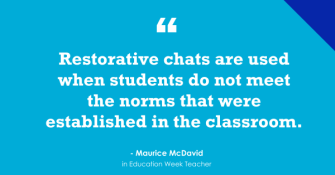
Restorative chats: Restorative chats are used when students do non see the norms that were established in the classroom. It tin can be one on 1 or can be washed with the whole class. Information technology is centered effectually the post-obit iv questions:
-
What happened? - This differs from what did you exercise and allows students to tell the whole story and feel heard.
-
What were you thinking at the fourth dimension? - This asks students to go dorsum through the mental process they used when making the decision to act outside of the norms. This is a meta-cognitive practice. It allows for reflection on what thoughts and/or emotions may have led to the behavior.
-
Who or what was harmed? - This question asks the student to be accountable for the idea that their behavior caused harm to someone or something. Students are quick to discover that they have harmed themselves and, oftentimes, come across how their beliefs has harmed a teacher or classmate. This builds empathy.
- How practice you repair the damage? - This question asks the student to think about how they can make the situation correct rather than simply serving a consequence that is not directly continued to the activeness. Students may offer to apologize or make clean upwardly a mess created. Students get to be a role of deciding what happens rather than having a determination made for them.
Starting "Small"
Timothy Hilton is a climate and culture specialist with the Fresno Unified school district, in California, where he coaches teachers on classroom direction and class climate. Timothy has over 10 years classroom-teaching experience at every level of social studies, ranging from Advanced Placement to English-language development. Timothy is currently a doctoral candidate at Claremont Graduate University in the field of educational policy, evaluation, and reform:
The Restorative practices world is a world that many educators fearfulness simply because they exercise not know a lot about it. Educators are rarely trained to an adequate level in how to make Restorative Practices (RP) work in their daily lives. Teachers are ordinarily shown the heavy-duty re-entry circles or disharmonize mediation to demonstrate the power of RP, but this oft leaves teachers intimidated, overwhelmed, and asking how this is going to work for them.
The best, and almost practical mode, to implement restorative practices in the classroom is to start small with some bones restorative skills that tin be proficient in your classroom, and even in your life outside of school. These skills are listening, affective advice, and curiosity questions. Once these skills have been practiced, lived, and embraced, then teacher tin begin working into the heavier-duty RP practices.
Listening: While the concept of listening seems self-explanatory, nosotros equally teachers practise not always practice it. We are often trying to do a million things at in one case and, in turn, never really heed to our students. Nosotros hear them, but practise nosotros listen? In a restorative classroom, there are a couple means nosotros can demonstrate that we are listening. First is by mirroring their emotions and feelings almost a topic. If they are serious when they are telling you lot something, then be serious every bit you heed. 2nd is by demonstrating active listening and paraphrasing. Saying things similar, "What I am hearing you say is ..." Tertiary is by beingness present and validating their feelings. If they are telling you something, make certain you are in the conversation and non planning your grocery listing. A big function of beingness nowadays is validating their feelings. You can do this by making statements such equally, " I empathize why yous are upset." Or, "I cannot even imagine what y'all must be feeling, but that you lot so much for sharing with me."
Affective Communication: Also known equally I-messages, these are powerful restorative tools that can be easily used in every classroom. These statements are done to connect the actions of your students to the impact they have on you. Affective statements require teachers to be willing to be honest and share their feelings. Melancholia statements follow simple formulas that tin exist used in every affective statement you make, "I feel/felt _____ when you _____." Some other case is, "I would like/what I need is _____." The statement frames can be combined or used independently and might look similar this, "I felt disappointed when I caught you adulterous on the test. " Or,
"I felt pitiful yesterday when I constitute out you lied to me considering I take always trusted you lot. I need yous to trust me enough to be honest with me. " These questions tie the deportment of an individual to the outcome they had, something students often forget about.
Curiosity Questions: These are 18-carat questions you would ask someone to larn more most their state of affairs. Imagine a student just does not seem to be having a skilful day. You can pull them aside and ask some marvel questions to detect out more than. Unproblematic questions like, "How are y'all doing today?" Or, "You seem kind of off today, is everything OK?" These questions assist dive into an issue, but curiosity questions can also help resolve a disharmonize, "How did information technology brand you feel when Tommy hitting you?" or "What practice you lot need Tommy to say to y'all to experience better?" These are just some very surface-level examples, but many more can be found online and in print resources.

Online Resource for Support
Ashley McCall is a 3rd grade English/linguistic communication arts educator at Chavez Multicultural Academic Center in Back of the Yards (Chicago) where she serves every bit a teacher representative on the local school quango. She is a Teach Plus Didactics Policy Fellowship alumna and a member of the Teach Plus Board:
Many districts that are new to restorative practices are nether the impression that it is a plan to implement. Information technology is not. Restorative practices are near shifting the mindsets and developing the capacity of stakeholders (students, families, teachers, administrators, receptionists, cafeteria staff, security staff, etc.) so they are invested in the culture and climate of the edifice and accept responsibleness for maintaining a safe, enjoyable, and productive environment for all involved. When stakeholders are invested and properly trained, nosotros are able to effectively sustain healthy school climates and respond finer to breaches in our social contract.
If you lot are looking to shift toward more restorative practices in your school, you demand buy-in beyond stakeholder groups. Consider how you lot (and a various group of stakeholders) volition make a instance for and create a sense of urgency around restorative practices at your schoolhouse. Consider how you can use data every bit a reflective tool (rather than a tool for shaming and punishment) to drive conversations around the culture, climate, and current disciplinary practices.
When yous accept buy-in, you demand ongoing preparation from experts. A three-day preparation on what restorative practices are, what they look similar at other schools, and what tools you can use is not acceptable and will likely get out your staff worse off than you lot began. Assess where you are as a school and make up one's mind what square you need to start on. If your campus has not still mastered potent relationships and relationship edifice, consider Capturing Kids Hearts for staffwide professional development. If your school is strong in relationships simply eager to develop specific restorative tools such equally restorative conversations, talking circles, or peace circles, consider applying for a Restorative Practice Coaching Project for your school.
Lastly, permit the nonadministrative staff take the reigns. Teachers demand to be at the forefront of their own mindset shifts and supporting the development of our colleagues. For example, every bit a part of a University of Chicago Teacher Leadership Bear upon fellowship this year, my colleague Lindsay Vocaliser developed a restorative practices resource for Chavez staff titled Connecting the Dots: How Restorative Justice, Social and Emotional Learning and Speaking and Listening Standards Come Together. Some of the key elements of this tool are that it is standards-aligned so teachers tin connect the dots on why nosotros should practice this work and how information technology maps onto the Mutual Core State Standards and the Achieve Evaluation. The tool is comprehensive and meets teachers where they are. Individuals can find a strategy they want to focus on and rail their development in that surface area throughout the year. The tool is also collaborative then staff can contribute resource that are working in their classrooms and breathe life into this shared professional-development resource.
Bank check out the Restorative Practices Guide and Toolkit created past the Chicago public schools' office of social & emotional learning, in collaboration with the Embrace Restorative Justice in Schools Collaborative. Evaluate where you lot are, make your case, collectively build/revise a vision for your schoolhouse's climate and culture, communicate and brand sure anybody tin clear the vision, outline a flexible short- and long-term map for bringing that vision to life, and evaluate implementation on an ongoing basis with quantitative data and qualitative information from all stakeholders. Remember that this is a long-term procedure. No 1 can undo decades of nada-tolerance-policy culture (or a no-suspension civilization) in one academic year. Policy modify does not result in overnight changes in practice, just we can each acuminate our restorative mindsets every day.

Conflict-Resolution Judgement Starters
As a career-long educator, Bryan Harris has served in a variety of roles from classroom teacher to district-level leader. Now working full time every bit a trainer, his work focuses on topics ranging from educatee appointment to teacher resiliency. Find out more at his website:
At the centre of restorative practices—in fact, it's right there in the name—is helping students learn how to repair and restore relationships after a conflict, hurt, law-breaking, or fight.
The distressing fact is that far likewise many of our students enter school without effective conflict-resolution skills. This includes the skill of recognizing when you've done damage to someone else and how to prepare it. Notice that I didn't say that kids don't have any conflict-resolution skills. The fact is that they do—information technology's just that many of the skills and communication methods they've acquired are non healthy or productive.
So, as teachers and leaders, what exercise nosotros practise?
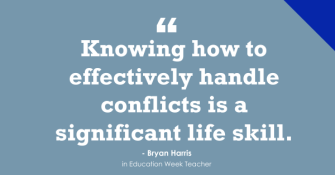
First, get-go by helping your students understand that conflict is a normal part of life. It's unavoidable. Merely the existence of conflict doesn't make you a bad person. It just ways that you spend time effectually other people; and when you lot spend time around other people, there volition exist occasions where you disagree. Knowing how to effectively handle conflicts is a significant life skill. To larn more about the nature of conflict, cheque out Larry'due south Classroom Q & A post from February of 2018. Forth with several other experts, I offered some ways to assist students think nigh and resolve conflict.
The first step is knowing that conflict is normal and cannot be fully avoided as long as y'all interact with other people. Once nosotros help our students understand this very important idea, helping them develop and refine skills that communicate remorse is a cracking next pace. In other words, teach them the power of an apology.
When students know how to sincerely offer and genuinely have an amends, it serves as the foundation to restore broken relationships.
Have you always seen something like this before?
Educatee A (we'll call them the offender) sheepishly walks over to Student B and says, "Lamentable." They mumble the word nether their breath while looking directly at the footing, arms folded the entire fourth dimension.
Student B (nosotros'll call them the victim) reluctantly says, "That's OK," while also looking at the basis and counting the seconds until they tin can run away.
In this all-as well-common scenario, both students are likely embarrassed, and the conflict is not resolved. While some of the right words were used, Student A didn't truly repent, and Student B didn't authentically accept it.
Imagine how different that interaction would exist if students used specific words and phrases that communicate remorse for the offense and acceptance of an apology. It might sound like this:
Educatee A: "I am sorry for drawing that moving picture of you and showing it to your friends. I realize that made you feel sad. I promise I'll never do that once more. Will yous please forgive me?"
Student B: "Since you promised to never practice that over again, I accept your apology."
Detect the divergence in the words. A bully first place to kickoff is by didactics students, by the utilize of sentence starters, which words are nigh effective at offering and accepting an amends. The following examples are corking places to start:
How to Offering an Apology
• I apologize for ...
• Information technology was my mistake that _______ happened. I repent for letting it happen.
• I realize that....
• I realize that _____ was my error and I am sorry for making you experience ________.
• I am truly sad that I did this. I want to make things better. Tell me how I tin can do that.
How to Accept an Amends
• I take your apology. Make sure this does non happen again.
• Because I know you will not practise this again, I take your amends.
• I'll accept your apology because....
• Considering you know that ______ was incorrect, I accept your amends.
• Because you lot know that ______ hurt me, I can have your apology.
To get more examples, click here to download a costless two-folio guide I've created that outlines v essential reasons that offering and accepting an apology is an important life skill for students.
Four Strategies for Promoting Restorative Practices
Kara Pranikoff is an uncomplicated schoolhouse teacher at a public school in New York City. Her book, Teaching Talk: A Practical Guide to Fostering Pupil Thinking and Chat (Heinemann, 2017), shares many ways to keep the balance of classroom give-and-take in the hands of the students:
It was a cute springtime morning in New York. I walked into the thousand to pick up my 2nd graders, and they swarmed to me, ready to begin our twenty-four hour period.
Hudson stood atypically off to the side. Bending downwardly to come across his eyes, I asked what was going on. "I don't want to talk well-nigh it now," he said quietly. "But may I give a public-service declaration when we become up to our room?"
"Public-service announcements" were statements that students needed to share with the rest of the community. Often these were letters that would increment our efficiency. (Tin everyone place their jackets on hooks so that the space stays neat?) Or messages that would help us work better together. (Remember, we demand to have a calmer scientific discipline class and so we can do our experiment.)
"I'd like to speak with everyone, even before we unpack," he requested. I was unsure about the content of his message, but it was articulate that Hudson needed to brainstorm our day.
Students entered the class, placed backpacks at their tables, and moved directly onto the carpeting. Hudson took a seat in the front corner of our meeting area, and I settled onto the demote in-betwixt his peers.
"I'm feeling a little distressing today," he began. "I just desire everyone to know that terminal night my dandy-grandmother died. I want anybody to know that I might not want to play very much today."
The grade responded with intendance. Some had questions that were typical of second graders trying to become the literal facts: How old was she? How did she dice? Then Hunter, Hudson's closest friend, raised her mitt. "How can nosotros help yous feel better?" she wanted to know.
Restorative practices are essential for a community to care for each other and grow together. Our best learning happens when we feel safe and secure. This priority requires attending each day in club to bring together an entire classroom of diverse students.
The tools which enabled the students to listen and support Hudson in his time of demand were put in identify in the autumn—nurtured and practiced each day—so that past springtime they could exist used, with independence. Here are some essential ways to develop these habits of mind:
Accept discussion in circumvolve every solar day
Information technology'due south said that 1 mode to accomplish closeness with others is to eat with them. Information technology'southward not only the literal nourishment simply the connection which is fostered by shut physical proximity. The classroom equivalent is to set aside a space where the whole customs can gather and face each other in a circle. This creates an surface area of inclusion where students tin share their thoughts and ideas.
Make space for students to speak and respond to each other independently
Students' ownership of their shared space requires the ability for them to express their thoughts freely. Speaking in partnership or small-scale groups can be woven into every twenty-four hours so that sharing and building ideas, independent of the teacher, is a regular exercise.
Invite the lives of your students into the classroom
Restorative practice honors the full beingness of each student. For this to happen, students must have the freedom to share what is on their mind. Nosotros must encompass the child as a whole, enabling them to express the joys that happen both inside and outside of school, likewise as the struggles.
Begin your day together
Each day we transition from our home infinite with family to our classroom community. By gathering as a whole class first thing every morning, we brand a commitment to welcome our 24-hour interval together. Nosotros can set our intentions and get our minds ready for what is coming ahead in our shared learning.

Thanks to Sheila, Maurice, Timothy, Ashley, Bryan, and Kara for their contributions.
Please feel complimentary to leave a annotate with your reactions to the topic or directly to anything that has been said in this post.
Consider contributing a question to be answered in a futurity mail service. You can send one to me at lferlazzo@epe.org. When you send information technology in, let me know if I can employ your real proper noun if it'southward selected or if you'd adopt remaining anonymous and take a pseudonym in mind.
You tin also contact me on Twitter at @Larryferlazzo.
Education Calendar week has published a collection of posts from this blog, along with new textile, in an east-volume course. It'due south titled Classroom Direction Q&Every bit: Adept Strategies for Pedagogy.
Simply a reminder; you can subscribe and receive updates from this weblog via e-mail or RSS Reader. And if you missed any of the highlights from the first 8 years of this weblog, you tin see a categorized listing below. The listing doesn't include ones from this electric current year, but y'all tin discover those by clicking on the "answers" category institute in the sidebar.
This Year's Virtually Pop Q&A Posts
Race & Gender Challenges
Classroom-Management Communication
All-time Means to Brainstorm the School Twelvemonth
All-time Ways to Terminate the School Year
Implementing the Common Core
Educatee Motivation & Social-Emotional Learning
Teaching Social Studies
Cooperative & Collaborative Learning
Using Tech in the Classroom
Parent Engagement in Schools
Education English-Language Learners
Reading Instruction
Writing Instruction
Instruction Policy Bug
Assessment
Differentiating Instruction
Math Instruction
Science Instruction
Advice for New Teachers
Author Interviews
Entering the Didactics Profession
The Inclusive Classroom
Learning & the Encephalon
Administrator Leadership
Teacher Leadership
Relationships in Schools
Professional Evolution
Instructional Strategies
Best of Classroom Q&A
Professional Collaboration
Classroom Organization
Mistakes in Education
Project-Based Learning
I am as well creating a Twitter list including all contributors to this cavalcade.
Look for Part Two in a few days.
The opinions expressed in Classroom Q&A With Larry Ferlazzo are strictly those of the author(s) and practice not reflect the opinions or endorsement of Editorial Projects in Education, or any of its publications.
Source: https://www.edweek.org/teaching-learning/opinion-ways-to-implement-restorative-practices-in-the-classroom/2020/01
0 Response to "Question Frames for 5th Grade Language Arts Common Core Test"
Post a Comment