Can You Drop a Profession in Wow and Laern It Again
Contents
- 1 Professions
- 1.1 Primary professions
- 1.2 Secondary professions
- 1.three Pseudo-professions
- 2 Categories of professions
- 2.one Gathering
- ii.2 Production
- 2.3 Service
- 3 Companion professions
- 3.1 Abracadabra
- 3.2 Blacksmithing
- iii.iii Cooking
- 3.4 Enchanting
- 3.5 Engineering
- 3.vi Inscription
- three.seven Jewelcrafting
- three.eight Leatherworking
- 3.9 Tailoring
- four Increasing professional person skill level
- 5 Proficiency levels
- half dozen Bonus to profession skill
- 6.ane Racial profession
- 6.2 Enchantments
- half-dozen.three Equipment
- 7 Bonuses yous only get with a certain profession
- vii.1 Abracadabra
- 7.2 Blacksmithing
- 7.3 Enchanting
- 7.4 Engineering science
- 7.5 Inscription
- 7.6 Jewelcrafting
- 7.7 Leatherworking
- vii.8 Tailoring
- viii Easy money making
- 9 Reputation
- 10 Trainers
- 11 Factions
- 12 Unlearning a profession
- 13 History
- 13.one Battle for Azeroth
- 14 Patch changes
- 15 Meet also
- 16 References
- 17 External links
A profession is a merchandise-oriented set up of skills that player characters may acquire and incrementally accelerate in guild to gather, brand, or enhance items that can be used in World of Warcraft gameplay. In essence, professions are 'jobs' characters may accept. Professions are learned and improved via a trainer for a nominal fee, or sometimes avant-garde with special recipes. Any profession tin be learned regardless of a character's faction, race, or class, although some racial traits provide bonuses to a particular profession. For example, gnomes have  [Engineering Specialization] which may assist them if taking up the Engineering profession.
Specific trade skills within a profession allow y'all to do specific things such every bit crafting or equipping certain items. The making of such items are learned straight from profession trainers, from recipes found throughout the world, or occasionally taught equally quest rewards. Each crafting profession starts out with a few specific trade skills that can be used to increase your skill level; equally a role player advances their profession to higher levels, they unlock the ability to learn new, more rewarding trade skills, which in turn are used to gain more skill levels (upward to the electric current maximum). Gathering professions, on the other hand, take no need of specific trade skills: The thespian advances their skill level simply by harvesting the appropriate raw materials from resource nodes throughout the world.
Note the stardom: Trade skills are capabilities within a profession—such equally forging a particular piece of armor—whereas skill level is a progression metric which acts as a prerequisite for learning more hard trade skills (in the case of a crafting profession) or harvesting greater amounts of raw materials (in the case of a gathering profession).
The Professions tab lists a character's professions, and provides easy access to all related abilities and crafting interfaces.
Professions
Three classes of profession exist: master, secondary, and so-called "pseudo"-professions.
Primary professions
Master professions are limited to two per character, though one is not required to take any at all. You can unlearn a primary profession in order to costless upward a profession slot and larn something new, but you will permanently lose all acquired knowledge and experience within that profession; if you acquire information technology once again later, you will have to start over from scratch.
| Profession | Category | Description |
|---|---|---|
 Herbalism | Gathering | Harvest herbs institute throughout the world and from the bodies of some creatures. You can detect nearby herbs on the minimap. |
 Mining | Gathering | Mine ore, stones, and raw gems from protruding veins or deposits. Also teaches you the smelting sub-profession, which allows the apply of a forge to smelt the ore into bars of metal. Yous can notice nearby ore deposits on the minimap. |
 Skinning | Gathering | Pare the corpses of certain creatures for their hides, leather, and scales. |
 Alchemy | Production | Mix potions, elixirs, flasks, oils and other alchemical substances into vials using herbs and other reagents. Your concoctions tin can restore health and mana, enhance attributes, or provide whatsoever number of other useful (or not-and then-useful) effects. High level alchemists can also transmute essences and metals into other essences and metals. Alchemists tin specialize as a Main of Potions, Master of Elixirs, or a Master of Transmutation. |
 Blacksmithing | Product | Smith various melee weapons, mail and plate armor, and other useful trade goods like skeleton keys, shield-spikes and weapon chains to forestall disarming. Blacksmiths can besides make various stones to provide temporary physical buffs to weapons. |
 Enchanting | Service, Product | Imbue all style of equipable items with magical backdrop and enhancements using dusts, essences and shards gained by disenchanting (breaking down) magical items that are no longer useful. Enchanters can also brand a few depression-level wands, likewise as oils that can be practical to weapons providing a temporary magical vitrify. |
 Engineering | Production | Engineer a wide range of mechanical devices—including trinkets, guns, goggles, explosives and mechanical pets—using metal, minerals, and rock. As most engineering products can simply be used by suitably expert engineers, it is not equally profitable every bit the other professions; it is, however, often taken to be one of the nearly entertaining, affording its adherents with numerous unconventional and situationally useful abilities. Engineers tin can specialize equally Goblin or Gnomish engineers. |
 Inscription  | Service, Production | Inscribe glyphs that modify existing spells and abilities for all classes, in addition to diverse scrolls, staves, playing cards and off-manus items. A scribe can as well create vellums for the storing of an Enchanter's spells and scribe-only scrolls used to teleport around the world (admitting a tad randomly). Also teaches you the  [Milling] ability, which crushes herbs into various pigments used, in plough, for a scribe'due south ink. [Milling] ability, which crushes herbs into various pigments used, in plough, for a scribe'due south ink. |
 Jewelcrafting  | Product | Cut and polish powerful gems that tin can be socketed into armor and weapons to augment their attributes or fashioned into rings, necklaces, trinkets, and jeweled headpieces. Also teaches yous the  [Prospecting] ability, which sifts through raw ores to uncover the precious gems needed for your craft. [Prospecting] ability, which sifts through raw ores to uncover the precious gems needed for your craft. |
 Leatherworking | Product | Work leather and hides into appurtenances such equally leather and mail armor, armor kits, and some capes. Leatherworkers can likewise produce a number of utility items including big profession numberless, ability-augmenting drums, and riding crops to increment mount speed. |
 Tailoring | Production | Sew material armor and many kinds of bags using dye, thread and cloth gathered from humanoid enemies during your travels. Tailors can besides fashion nets to slow enemies with, rideable flight carpets, and magical threads which empower items they are stitched into. Since patch 8.0.1 likewise be able to craft bandages. |
Secondary professions
Secondary professions can be learned by any character regardless of their choice of primary professions, and tin can provide the player with a number of benefits, resources and side activities. Dissimilar primary professions, secondary professions cannot exist unlearned: Since there is no limit to how many you tin can accept at ane time, there is merely no bespeak in beingness able to drop them.
| Profession | Category | Description |
|---|---|---|
 Archaeology  | Gathering | Unearth and reconstruct valuable artifacts from the cultures across Azeroth and across, often earning unique and mysterious rewards. |
 Cooking | Product | Combine ingredients into delicious food that can restore wellness and mana and provide temporary buffs. These buffs can increase nearly any attribute, and some give you unusual passive abilities. Also teaches y'all the power to create campfires, which are usually required to cook. |
 Fishing | Gathering | Fish from lakes, rivers, oceans and more using a  [Fishing Pole] . The items y'all fish up can be anything from greyness junk to epic treasures and even rideable mounts! [Fishing Pole] . The items y'all fish up can be anything from greyness junk to epic treasures and even rideable mounts! |
| Profession | Category | Description |
|---|---|---|
 Commencement Assist | Service, Production | Weave and utilise cloth bandages and poison-cleansing anti-venoms. Considered a must-have profession for all classes who are not able to heal themselves by magical means. |
Pseudo-professions
Pseudo-professions are dissimilar master and secondary professions in that they are either learned or leveled in unusual ways; some are automatically bachelor to specific classes—similar to abilities—while others are purchased outright, requiring no thespian interaction to increase.
| Profession | Category | Description |
|---|---|---|
 Lockpicking | Service | Allows a rogue to open locked chests, doors, and lockboxes. Lockpicking originally required manual leveling much like a profession, but was changed in the Cataclysm expansion to simply increase incrementally equally a Rogue increases in level. Like a service profession, lockpicking skills are often in demand and are marketed and solicited on the chat system trade aqueduct. |
 Riding | N/A | Ride footing, flying, and swimming mounts of all shapes and sizes. Riding is taught similar a profession, but each major proficiency level simply improves your power to ride mounts of additional types or at faster speeds. It requires a much higher level and carries a much college toll than a normal profession, and while information technology apparently neither gathers nor produces, at that place are some mounts which allow passengers and could conceivably be used to provide transportation as a service. |
 Runeforging | N/A | Allows a expiry knight to emblazon their weapons with empowering runes, like to Enchanting. |
| Profession | Category | Description |
|---|---|---|
 Poisons | N/A | Allows a rogue to create poisons which tin can be applied to their weapons, calculation a chance on hit to proc extra effects or damage. |
Categories of professions
Each profession falls into at least one of iii categories: Gathering, production, and service. Overlaps betwixt these categories are common, and a profession of one type often has some functions that are of another type.
Gathering
Gathering professions allow a graphic symbol to gather or harvest items from resources nodes throughout the game world to supply ingredient materials (or mats) for crafting professions. Occasionally, these harvested items volition be directly useful and usable. Whatsoever gathered materials that practise not demark on pickup can be sold in the auction house, often for a tidy profit for the time invested.
Production
Production professions brand items from other ingredient items such equally herbs, ingots, and meats. While Blizzard once referred to these as "Production" professions,[1] almost players refer to them as simply crafting within the game. Most of the items produced will be directly useful, but some will be ingredients for more advanced or circuitous items. Crafted products that practice not bind on pickup can be sold in the auction business firm, with more than powerful or novel items commanding higher prices.
- The outset recipes you get are useful for gearing up depression level characters (bold a college level character is not helping to support you). Some contend that as presently as you start running instances, the drops volition commonly be amend than most crafted items from the aforementioned level, but this is not always the example; crafted items volition oftentimes provide comparable stats or utility benefits that are useful for characters of all levels.
- High-end crafting, including specializations, can exist extremely useful and lucrative, especially when utilizing recipes earned through end-game faction reputations or example drops (some of which demark on Pickup, increasing their rarity). There are also several quests which require crafted items for completion.
Service
Service professions benefit players by providing a service such as item enhancement rather than focusing on the production of the items themselves. Characters that want to make coin with a service profession will often accept to actively solicit customers, though quality-of-life improvements such equally the improver of Enchanting Vellums have profoundly diminished this demand over time.
Companion professions
While it is perfectly valid to choose whatever two primary professions you like, certain professions complement others in a way that makes them natural companions. The best example of this is the most typical: Pairing a crafting profession with the gathering profession that provides the bulk of the materials required to advance in that crafting profession.
Effectively pairing complementary crafting and gathering professions profoundly reduces a character's reliance upon the auction house for materials. While this can be a good matter for players without a large sum of aureate or a steady stream of income, keep in mind that gathering can consume a cracking bargain of time and may all the same not provide all of the reagents necessary for your craft. Therefore, adherents to the old aphorism "time is money, friend!" must make up one's mind what is more valuable to them: The gold saved by gathering your own materials, or the fourth dimension saved by purchasing materials gathered past others.
The post-obit is a table of crafting professions and the principal and secondary companion professions that are most complementary to them. If you lot have no existent interest in crafting, consider instead taking two gathering skills to make money while adventuring in the world.
| Profession | Recommended Companion | Alternate Companion | Secondary Companion |
|---|---|---|---|
| Alchemy | Herbalism | Mining | Line-fishing |
| Blacksmithing | Mining | - | - |
| Cooking | - | - | Fishing |
| Enchanting | Tailoring | Leatherworking | - |
| Engineering | Mining | - | - |
| Inscription | Herbalism | - | - |
| Jewelcrafting | Mining | - | - |
| Leatherworking | Skinning | - | - |
| Tailoring | Enchanting | Skinning | - |
Alchemy
The best companion for this profession is Herbalism, as early alchemy relies almost exclusively on herbs for the mixing of any potion. The secondary Line-fishing profession is also highly recommended, equally it supplies a number of oils used in the craft and tin can be taken simultaneously with Herbalism. At higher levels, Mining can be used to provide materials for some potions too every bit transmutes.
Information technology may be useful for advanced players to check your server'south auction firm prices for herbs and minerals, choosing to assemble 1 or the other depending on which has the highest profit margin. You can so sell your excess material and employ the profits to purchase the materials you cannot obtain for yourself. New players should stick with Herbalism and Fishing until they get used to dealing with the auction house.
Blacksmithing
The best companion for this profession is Mining, every bit the ore used in most all smithing plans is typically in loftier demand and thus expensive to purchase on the sale firm. While blacksmithing does utilize components from other professions (mainly leather from Skinning), information technology does not do and so in sufficient quantity to justify any other gathering profession. In improver, low-level blacksmithing items rarely sell for more the toll of their materials, and the boosted income from selling backlog ore can help to offset this toll until you tin produce rare and in-demand weapons and armor.
Cooking
While Cooking is a secondary profession and utilizes many dropped meats from creatures in the game, its natural companion is Fishing. It can be leveled without the use of fishing (a noted departure from when information technology was originally introduced to the game), but communicable and cooking fish is a very efficient method for increasing your skill. Don't forget that since both cooking and fishing are secondary skills, you tin have both of them in improver to two primary skills.
Enchanting
Enchanting actually provides its ain pseudo-gathering skill, known as disenchanting, which is used to suspension downwards items of uncommon quality or better to produce the materials needed to enchant other items. It is therefore common practise to couple Enchanting with Tailoring, which similarly requires no gathering skills and can produce many items that tin can be disenchanted. If you do not similar farming for cloth and the toll of leather is cheaper on the auction house, Leatherworking can also produce items suitable for disenchanting. This combination—though non unheard of—is not common, as anyone tin farm for cloth while simply someone with the Skinning profession can obtain the leather needed by Leatherworkers.
Note that it is also customary for Enchanters to farm disenchantable items from instanced dungeons and to buy up cheap disenchantable items from the sale house to provide the materials needed for their craft. This has long since given Enchanting a reputation for beingness one of the nigh difficult and expensive professions to level up—a reputation which has increased its rarity, and therefore its profit margins equally well.
Engineering
The best companion skill for this profession is Mining, as ore is typically in loftier demand and thus expensive to purchase on the sale house and, like Blacksmithing, Engineering is ore intensive. Dissimilar Blacksmithing, however, it is too stone intensive and uses a fair number of gems, which Mining besides provides. While this profession besides uses items provided by Skinning (again similar to Blacksmithing), it is non in sufficient enough quantity to justify non taking Mining.
Inscription
The just truly worthwhile companion skill for Inscription is Herbalism. Using the associated [Milling] skill, Scribes gather herbs to be made into diverse pastes (known as pigments) that are later on used as the basis for inks for their profession.
Jewelcrafting
The best companion skill for this profession is Mining, as ore is typically in high need and thus expensive to purchase on the auction house. Like Blacksmithing and Engineering, Jewelcrafting is ore and stone intensive. Additionally, Jewelcrafting needs gems, which are obtained either directly from mining or from [Prospecting] mined ore. Jewelcrafting uses and so little from other professions that it is not advisable to couple it with anything other than Mining.
Leatherworking
The best companion skill for this profession is Skinning, as it produces nigh all of the raw materials needed to work leather. Additionally, you lot don't have to kill an enemy yourself in society to skin information technology; any skinnable creature that has been killed and looted can be skinned for leather, hibernate or scraps that a leatherworker can turn into usable pieces of leather or items. Like many professions, Leatherworking does occasionally utilize other professions' crafted or gathered materials. Withal, these are not in sufficient enough quantity to warrant the omission of Skinning.
Tailoring
Unlike nigh chief professions, Tailoring has no associated gathering profession as most of the raw materials are obtained by farming cloth from humanoids in the game. Yet, it is nonetheless commonly coupled with a gathering skill—Skinning, Herbalism, or Mining—or with Enchanting, which similarly provides its own raw materials. However, except for Skinning to a small degree, none of these are for the purpose of helping with Tailoring proper. Rather, they are all for either making money on the auction house from selling raw goods to other professions, or for providing uncommon quality or better items to be disenchanted.
Tailors that do not wish to pick upwards the Enchanting profession should consider Skinning. The reason for this is twofold: First, Skinning provides a few items needed by tailors (such as leather for tailored boots or bags). Secondly, both Skinning and Tailoring are professions that rely upon gathering items from mobs that you will exist killing anyhow. In other words, if you impale a humanoid, it will most likely exist dropping cloth for your tailoring; meanwhile, if you kill a beast or dragon, y'all tin can skin it to grab useful materials. Having both Tailoring and Skinning is a great way to both save and make money at the auction house.
Increasing professional skill level
Skill level is increased by practicing the skill. This works differently for different professions.
For most professions, yous take a take a chance to gain skill level as y'all craft items, perform your service, or gather from a resource. As you increment in a skill, more recipes and resources reach a 0% gamble to increase the skill (at this indicate the recipe will announced grey in the profession window). When a recipe turns dark-green, a skill raise seldom occurs. A xanthous recipe volition heighten the skill by 1 point roughly 60% of the fourth dimension. An orange recipe ever raises the skill 1 point.
The chance of skilling up changes within a color band likewise. For example, if a particular item goes from orange to yellowish at 240 and from yellow to green at 255, the chance of skilling up will be most as skilful as orange from 240-245, middling from 245-250, and barely better than greenish from 250-255. Information technology is ofttimes beneficial to make loftier xanthous items to skill up more cost-finer than orange items, but depression yellow items should only exist used if inexpensive (or if profitable!).
The formula describing the chance to proceeds a skill level, given your current skill level, the level at which the pattern you are using turns "yellowish", and the level that it turns "grayness", appears to exist[two]:
chance = (greySkill - yourSkill) / (greySkill - yellowSkill)
This ways that a recipe that has merely turned yellow volition however be guaranteed to grant a skill point for its next craft (in the above formula, if yourSkill and yellowSkill are the same, the result is 1). Information technology can be observed that the level at which recipes turn green is the point where the chance of a skill-upward is 0.5. Thus, yellow recipes take a skill up chance tending from 1 to 0.v equally the recipe approaches greenish. The number of crafts of a recipe required to get i skill-upwards is geometrically distributed, thus the expected number of crafts is given by 1/risk. This may help in which recipe is the 'cheapest' to employ to level up regarding textile cost.
One exception to this dominion is Skinning, wherein skinning a corpse which appears orange does non guarantee a skill increase, and frequently many such corpses must exist skinned in social club to raise the skill).
Line-fishing also works differently. Each particular fished has a contribution to raising your angling skill, regardless of the detail level fished or the location fished. Raising your fishing skill requires progressively more than catches, simply it doesn't matter where y'all fish nor what you catch (other than yous will miss more fish in more hard areas where yous have a adventure to miss some fish, so it volition take longer - then raising fishing skill can exist inversely related to the difficulty of the fishing.)
Creating a Basic Campfire has a chance of increasing cooking skill. This has 5 min cooldown so it is not so useful.
Proficiency levels
There are nine proficiency levels that constrain how much skill players can larn inside their professions. Apprentice, Journeyman, Skillful, and Artisan no longer appear in game and are rolled upward nether Classic. Journeyman and Expert are only referenced in profession achievements.
| Championship of Professional person Proficiency Level | Min Required Character Level | Min Required Professional person Skill Points | Max Allowed Professional Skill Points | Toll to train | Note |
|---|---|---|---|---|---|
| Classic proficiency | v | none | 300 | Principal - 10  (at Neutral) (at Neutral)Secondary - one  (at Neutral) (at Neutral) | Some specializations are done during this level. |
| Outland proficiency | x | ane | 75 | 10 (at Neutral) | Tailoring and Abracadabra Specializations are done during this level. |
| Northrend proficiency | 10 | i | 75 | 10 (at Neutral) | |
| Cataclysm proficiency | 10 | 1 | 75 | Primary - x (at Neutral) Secondary - i | |
 Pandaria proficiency Pandaria proficiency | 10 | 1 | 75 | ten (at Neutral) | |
 Draenor proficiency Draenor proficiency | x | 1 | 100 | Learned from manuals that are quest reward and drops/gathered in Draenor. | |
 Legion proficiency Legion proficiency | 10 | 1 | 100 | ten (at Neutral) | |
 Battle for Azeroth proficiency Battle for Azeroth proficiency | 10 | i | 175 | x (at Neutral) | |
 Shadowlands proficiency Shadowlands proficiency | fifty | 1 | 150 |
Bonus to profession skill
You can as well increase your profession skill level with certain racial abilities, items, and enchants. Principally the hazard to skill up is based on the characters base skill level - i.e. the skill level before the racial or item bonus. This makes it much easier to level up the skill. The Draenei Jewelcrafting skill bonus of 5, for case, means that a recipe that turned from orange to yellow at 30 for other races would not turn yellow until 35 for a Draenei jewelcrafter.
You must have training in the profession (at to the lowest degree one skill betoken) to use a skill bonus in that profession. With no training, the skill bonus does not apply - so you cannot use the skill bonus instead of training in a profession.
Racial profession
Certain races receive a profession skill bonus every bit a racial trait.
Enchantments
Sure enchantments create a permanent profession skill bonus on an apparel item, which is and then worn to apply the profession skill bonus. Currently, all of these work on gloves.
Casting these enchantments on a very low level non-binding white or gray quality cloth glove enables the glove to be worn by whatever grapheme. This will as well prevent anyone from accidentally disenchanting the glove. (The materials for the enchantment cannot e'er be recovered in any case.)
(Some folks may prefer the enchantment on a Bind on Equip glove they can't accidentally give abroad.)
The herbalism enchantment tin be cast on [Herbalist's Gloves] for a total bonus of +7 or +x herbalism skill. This is the simply fashion to get both bonuses at once since individual herbalism skill bonus items would occupy the same equipment slot.
Equipment
Sure items give profession skill bonuses when wielded or worn.
Bonuses you only get with a certain profession

Each Primary profession gives certain advantages unique to practitioners of that profession. The crafting profession bonuses, by design, are all roughly comparable: nigh forty points of detail upkeep (i.due east., 40 points to a statistic other than stamina, 60 points of stamina, or 80 points of attack ability). At that place are only a few gaps - for example, there is no tailoring bonus useful to tank.
Since the release of Wrath of the Lich King, no profession has had bind on pickup items of great value. Several professions have bluish quality items that will be useful to fresh level 80s, only quickly replaced with improve gear.
The crafting professions each have recipes for items that require skill in that profession.
Alchemy
Alchemists are able to create and equip unique trinkets, ranging from the  [Philosopher's Stone] (200) to a option of max level versions such as the
  [Vibrant Alchemist Rock] . In improver to being a required tool for transmutations, these trinkets grant substantial amounts of primary and secondary stats, as well as increasing the upshot that healing and mana potions have on the wearer past forty%.
In add-on, midway through Apprentice level (fifty skill), Alchemists get a passive ability,  [Mixology] , that doubles the duration of any elixir (or flask) that they utilize, provided that it is i they are able to make themselves. This ability also increases the effect of the elixir, just the corporeality of increment varies from particular to item.
Alchemists are besides able to make a small-scale collection of potions that only they are able to do good from. At 1000 Primary (400) alchemists can create the  [Countless Mana Potion] and
  [Countless Healing Potion] , which are not consumed upon use. These tin can provide a regular and endless supply of mana or health, although their contributions (2000 and 2400 respectively) are far less significant at max level. One thousand Chief besides brings the
  [Flask of the North] , which provides a small buff to the alchemist'south primary stat, effectively replaced at Illustrious Grand Principal (500) skill level by its Cataclysm equivalent, the
  [Flask of Enhancement] . Although these flasks provide a much smaller bonus than other flasks at that skill level, they are not only non consumed upon apply simply have the advantage of being usable in Arenas.
- Encounter also Items merely usable by alchemists
Blacksmithing
The near notable exclusive benefit Blacksmiths go is the ability to add together a socket to bracers and gloves, that requires 400 Blacksmithing skill to remain active. (This makes Blacksmithing an attractive complement to Jewelcrafting, for players who are not worried nigh gaining required materials.)
Blacksmiths can also create skeleton keys to open locked doors and chests, providing a express alternative to a rogue's lockpicking services.
In addition, Blacksmiths are able to craft gear that but they can wear, dependent on the specialization they have called: weapons or armor. These items become available at several points:
-
Character
levelSkill level 47 260 65 330 70 350 78 415
- See also Armorsmithing plans, Weaponsmithing plans, Skeleton keys
Enchanting
Enchanters are able to enchant their rings with effects that are roughly comparable to an additional cut gem.
Applied science
Virtually every detail an engineer makes is usable only by other engineers, making it hard to compare to other professions. They have custom made items that do everything from snare or mind control opponents to gaining access to a mailbox or banking company space in the eye of the wilderness.
Much like Blacksmiths, they are able to make a small-scale selection of items (headgear) sectional to engineers.
And in mutual with most other crafting professions, they are able to broaden select items of their own gear. While nearly of these changes are gadgets (increased move speed, rockets, parachutes), many also give bonuses to combat statistic abilities (armor value, disquisitional strike rating, haste rating, etc).
In common only with Tailoring, there are two mounts that just Engineers tin create and use. (There are a further ii mounts - the motorcycles - that require engineering to create, but anyone can use.)
Inscription
Scribes at Grandmaster level (400) are able to put powerful enchantments (Inscriptions) on their shoulder items. This besides saves players the carp of grinding Sons of Hodir reputation.
Beyond that, they are able to use Scrolls of Recall, which act much like the Shaman  [Astral Recall] power, with shut to the same cooldown period.
Jewelcrafting
Starting equally depression as level 35, and continuing at least to level 75, Jewelcrafters are able to make trinkets that merely they are able to apply (BoP).
More meaning than those trinkets, though, is the ability of Jewelcrafters to create and socket more than powerful ballsy quality gems. These gems (upward to iii allowed at a time) are upward to 40% more powerful than the best gems that non-jewelcrafters tin can obtain. Much like Blacksmithing and Enchanting, this provides benefits approximating having an additional two gems installed in your gear.
- Run into also Jewelcrafter only designs
Leatherworking
Leatherworking allows the practitioner to augment their bracers (a substitution for normal enchantments), and their leg items. (Leg enchantments are typically done through leatherworking anyway; the Leatherworker-only versions are far cheaper but equal in power.)
As with Blacksmiths, Leatherworkers are able to create a off-white pick of armor items that only they may utilize, at pretty much the same levels as blacksmiths, just defective the recipes at 415 skill/level 78.
- See also Fur Lining and Leg Reinforcements
Tailoring
Tailoring, like Leatherworking, provides inexpensive top-end leg enchantments, albeit for spellpower rather than melee abilities. It also allows the tailor superior enchantments for cloaks (providing i of several varieties of 'proc' buff.
Tailoring, like Engineering, has a pair of unique flying mounts that simply Tailors can ride.
Lastly, tailors gain a passive power, Scavenging, that allows them to loot extra cloth off of Northrend humanoids.
- Meet also Embroidery
Piece of cake money making
- Master article: Guide to making money
Every profession offers opportunities to make money. The gathering professions offer an obvious avenue: Sell what was gathered. Some of the crafting professions also have "value added services". The value of those services depends on the marketplace prices for the source and completed items, or upon the price players are willing to offering for the "cooldowns".
Reputation
All of the skills have reduced cost to train depending on your reputation with the Faction to which the trainer belongs. Since you tin can generally have at least one reputation at Honored by 20th level, selecting where to train will save yous 2 50 (five% as compared to the cost when Friendly). This is also true for all recipes for the building professions.
Trainers
- The Trainer page has links to a comprehensive list of trainers for each profession/skill.
- The Profession trainers past skill page is currently incomplete and out of date.
Factions
Many expert loftier-level recipes are sold past factions. Faction grinding keeps many crafters busy for several weeks and can often exist very expensive if you are not backed by a society. It is not uncommon for a crafter to start out with two collecting professions (normally Skinning/Mining or Skinning/Herbalism), after acquire the start production arts and crafts, and in the end learn a second product craft to maximize benefit from the faction.
Unlearning a profession
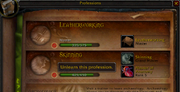
The profession unlearn icon
You may unlearn a profession and start a new one but this removes the chosen profession. If you lot were to acquire it again, you would have to start leveling information technology from a skill level of 1 again. You will as well forget any recipes yous may have acquired in your former profession, so they must be reacquired if you take information technology up again. Note, withal, that y'all do not unlearn your speciality, if you accept one. If you lot later re-acquire an unlearnt profession for which you lot had a speciality, you will notwithstanding have the speciality. The new profession you choose to replace it with also starts with a skill level of i. You can unlearn a profession from your skills tab (the hotkey is k). To do so, click on the advisable profession, and in the lesser part of the console is a tiny icon that when moused over will tell yous information technology lets you unlearn your profession. Exist sure yous really want to unlearn a profession; Blizzard will not undo it if you change your heed!
One way to make employ of this is to wait at primary professions from a different perspective. You can only have two. But they are not 'cast in concrete', you tin can discard a chief profession and replace information technology. And they are clay cheap - Apprentice level training in a main profession costs nine copper in your starting expanse. When you are commencement starting, you might do good by switching professions to meet a goal. You can use this to get a fair upgrade to your starting gear cheaply, and stock upward on some low level consumables.
The downside is that you lose all of your congenital upwards skill and recipe knowledge. Some profession mounts will non be rideable until you gain the requirements again, but will still exist in your mount list and count towards achievements.
History
New professions have been added through expansions and patches.
| Expansion | Profession | Type |
|---|---|---|
| | Jewelcrafting | Primary |
| | Inscription | Principal |
| | Archaeology | Secondary |
Jewelcrafting could originally only be learned on accounts that had the Burning Crusade expansion enabled, as trainers for this profession were located in expansion-exclusive areas. These trainers were added to the old-world cities in the Cataclysm expansion, making Jewelcrafting available to archetype accounts.
In contrast to the initial exclusivity of Jewelcrafting, trainers for the Inscription profession were introduced directly to former-world cities with the pre-patch for Wrath of the Lich King, making it immediately available to all players.
Archeology was initially restricted to owners of the Cataclysm expansion; this expansion was integrated into the base World of Warcraft parcel in October of 2013.
Battle for Azeroth
- Each profession will now be separated into expansions and leveled separately from one another. However, Archaeology was unaffected.
- Each expansion will have its own leveling path for items from that expansion, similar to the Mists of Pandaria cooking ways.
- You lot can cull to go back and level older expansion crafting, or you can only level the current expansion.
- This allows you lot to craft items with electric current expansion materials without needing older expansion materials to level.
- You tin still go back and level older expansion crafting skills as well.
- To clarify further, an case of this ways that you lot can level your "Cataclysm Tailoring" by crafting Cataclysm patterns, just this doesn't stop you from progressing your "Kul Tiran / Zandalari Tailoring" from with the new expansion'southward patterns.
- Get-go Assistance was removed and its patterns were redistributed into Tailoring and Alchemy. Most First Assist crafts volition have to exist relearned in their respective new profession.
Patch changes
Run into also
- Beginner'due south guide to professions for helpful full general info.
- Choosing your master professions discusses your options.
- Farming is a term used to describe the act of gathering reagents/materials to brand Profession items — commonly referring to hard-to-discover ingredients. See the Places to Farm article for more details.
- Factions.
References
- ^ Earth of Warcraft: Professions. Blizzard Entertainment. Archived from the original on 2007-10-31.
- ^ http://www.wowhead.com/spell=56462#comments:id=479890
External links
- For leveling guides delight visit Tradeskill leveling guides
| Professions | |
|---|---|
| Principal |
|
| Secondary |
|
 Abracadabra
 Blacksmithing
 Enchanting
 Engineering
 Herbalism
 Inscription
 Jewelcrafting
 Leatherworking
 Mining
 Skinning
 Tailoring
 Archaeology
 Cooking
 Fishing
 Riding
Source: https://wowpedia.fandom.com/wiki/Profession
0 Response to "Can You Drop a Profession in Wow and Laern It Again"
Post a Comment